



மலைபடுகடாம் 1
பாடல் · The poem
Tap a word to see where else it occurs.
பொருள் · Meaning in TamilAI
மேகம் திரண்ட கரிய வானத்தில் முழங்கும் இடியோசை போல ஒலிக்கும் வகையில் பண் அமைத்த முழவு, ஆகுளி, பாண்டில், மயில்தோகை அணிந்த கொம்பு, தூம்பு, இனிய குழல், தட்டை, எல்லரி, பதலை முதலிய இசைக்கருவிகளை, மழைக்காலப் பலாமரத்தின் காய்க்குலைகள் போலப் பைகளில் கட்டித் தோளில் காவடியாகச் சுமந்து, கடினமான சிறு மலைப்பாதைகளில் நீங்கள் செல்கிறீர்கள். அம்பு ஏந்திய கானவர் வழிப்போக்கர்களுக்குத் துன்பம் செய்யாமல் வழிகாட்டும் மலை உச்சியில் நடக்கிறீர்கள். வளையல் போன்ற திவவும், நன்கு முறுக்கிய நரம்பும், பசை கொண்டு சேர்த்த பத்தலும், புதிதாகப் போர்த்த பொன்னிறத் தோலும் கொண்ட பேரியாழ், மணமகளின் வயிற்றில் ஓடும் மெல்லிய மயிர் ஒழுங்கு போல அழகாக இருக்கிறது. அரச அவைக்கு ஏற்ற அந்த யாழை இசைக்கும் பாணர்களுடனும், கல் உரசிய சிறிய பாதங்களுடன் களைத்து, மயில் கூட்டம் போலக் கூந்தலை விரித்து இளைப்பாறும் விறலியருடனும், குளிர்ந்த நிழலில் தங்கியிருக்கும் கண்ணுளர் கூட்டத்தின் தலைவனே!
கரைகளை மோதிக் கடலை நோக்கி ஓடும் ஆறு போல நாங்கள் அவனிடமிருந்து வருகிறோம். பழம் நிறைந்த காட்டை நோக்கிப் பறக்கும் பறவைகள் போல நீங்களும் நன்னன் சேய் நன்னனிடம் செல்ல நினைத்தால், நல்ல நேரத்தில் வந்த பறவைகள் நீங்கள். என்னைச் சந்தித்ததால் சொல்கிறேன், கேளுங்கள்: வழியின் நீளம், தங்கும் இடங்கள், அவன் நாட்டு உணவு, மலைகள், சோலைகள், காடுகள், உலகம் உள்ளவரை நிற்கும் அவன் புகழ், பகைவரை வென்று கொண்ட அரிய அணிகலன்களைப் புலவர்களுக்கு மழை போலக் கொடுக்கும் அவன் வள்ளன்மை, இகழ்பவரை அடக்கும் வலிமை, புகழ்பவருக்கு நாடு முழுவதும் கொடுத்தாலும் நிறைவடையாத அவன் உள்ளம், நாள்தோறும் நடக்கும் அவன் மகிழ்ச்சியான அவை, அவைக்கு வரும் திறமையற்றவரையும் காத்து வழிநடத்தும் அவன் சுற்றத்தாரின் நல்ல பண்பு, நவிர மலையில் வாழும், நஞ்சு உண்ட இறைவனின் இயல்பு, சூரியன் போன்ற அவன் சிறப்பு, பகைவர் நாட்டை வென்று புலவர்களுக்குக் கொடை வழங்கிய அவன் முன்னோர் வரலாறு, முதலைகள் வாழும் அகழியும் வானளாவிய மதிலும் கொண்ட அவன் பழைய ஊர் ஆகிய எல்லாவற்றையும் கேளுங்கள்.
நீ வேளைத் தேடிச் செல்லும் திசையில் உள்ள அவன் நாட்டின் இயல்பு இது: இப்போது அங்கே புது விளைச்சல் வந்துள்ளது. இடைவிடாது மழை பெய்ததால் விதைத்தவை எல்லாம் விளைந்தன. வானில் விண்மீன்கள் போல முசுண்டைக் கொடி வெண்மையாகப் பூத்தது. எள் காய்த்து நெய் நிறைந்தது. தினைக்கதிர் யானைக்கன்றின் துதிக்கை போல வளைந்து அறுவடைக்குத் தயாரானது. அவரை காய்த்தது, வரகு அறுக்கப்பட்டது, ஐவன நெல் விளைந்தது, கரும்பு ஆலையில் சுழல்கிறது. இஞ்சியும் கிழங்குகளும் முற்றின. வாழை, நாவல், மா, ஆசினி, பலா ஆகியவை பழுத்துத் தொங்குகின்றன. தீ போன்ற செங்காந்தள் மொட்டை இறைச்சி என்று எடுத்த சேவல், அது இறைச்சி அல்ல என்று கீழே போட்டதால், அதன் இதழ்கள் வெறியாட்டுக் களம் போலப் பாறைகளில் சிதறி, மலைச்சாரல் திருமண வீடு போல மணக்கிறது.
அங்கே தேனும் கிழங்கும் இறைச்சியும் கொண்டுவரும் கானவரின் சிற்றூருக்குச் சென்றால் நிறைய உணவு பெறுவீர்கள். அன்று இரவு தங்கி, செயலைப் பூ சூடி, மலையடிவாரச் சிற்றூரை அடைந்து, “வெற்றி வேளின் இசைக்கலைஞர்கள் நாங்கள்” என்று சொன்னால், சொந்த வீடு போல உள்ளே அழைத்து, உறவினர் போலப் பழகி, இனிய சொல் கூறி, நெய்யில் வெந்த இறைச்சியுடன் இறடிச் சோறும், மூங்கிலில் விளைந்த தேன் கள்ளும் தருவார்கள். மறுநாள் காலையில் மான் இறைச்சி, முள்ளம்பன்றிக் கொழுப்பு, புளிப்புச் சேர்த்த மோர், மூங்கில் அரிசிச் சோறு ஆகியவற்றைக் குறப்பெண் சமைத்து அன்புடன் வீடுதோறும் தருவாள். அதனால் அரசனிடம் பெற வந்த பரிசையே மறந்து நீண்ட நாள் தங்கிவிடவும் கூடும்.
ஆனால் அவன் மலைநாடு அவ்வளவு மட்டும் அல்ல. குவளைப் பூவைத் தொட்டாலும், மலைத் தெய்வப் பெண்கள் இருக்கும் இடத்தைப் பார்த்தாலும் நடுங்க நேரலாம். எனவே பல நாள் தங்காமல் சமவெளி நோக்கிச் செல்லுங்கள். பன்றிக்கு வைத்த கல் பொறிகள் உள்ள வழியில் இரவில் போகாமல் விடியலில் செல்லுங்கள். பாம்பு ஒளியும் குழிகள் உள்ள பாதையில் மரத்தைத் தட்டிப் பார்த்துச் செல்லுங்கள். தெய்வம் உள்ள இடத்தை வலம் வந்து வணங்கிச் செல்லுங்கள். யானையை விரட்டக் குறவர் கவணில் வீசும் கல் கூற்றுவன் போல வருவதால், மரங்களின் மறைவில் செல்லுங்கள். முதலை வாழும் ஆழமான கயத்தைக் கடக்கும்போது கொடிகள் சுற்றிய மரத்தைப் பற்றிக்கொண்டு, குழந்தைகளுடன் ஒவ்வொருவராகக் கவனமாகக் கடந்து செல்லுங்கள். பாசி படிந்த வழுக்கும் இடங்களில் கோல் ஊன்றிச் செல்லுங்கள். தெய்வம் உறையும் இடங்களில் வீணாக இசைக்கருவிகளைத் தொடாதீர்கள். தேன்கூடுகளையும் மயிலையும் குரங்கையும் திடீரென்று உற்றுப் பார்க்காதீர்கள். அம்பு பட்டு வீழ்ந்த பன்றியைக் கண்டால், புகை மணக்காமல் சுட்டு உண்டு, குவளைச் சுனையில் நீர் பருகி, இரவில் நடக்காமல், கல் குகைகளில் வீட்டில் தங்குவது போலத் தங்குங்கள். மலைப்பாம்பையும் நச்சுப் பூக்களையும் பழங்களையும் விலக்கி, அடையாளம் அறிந்து செல்லுங்கள். வழி தவறச் செய்யும் அடர்ந்த காட்டில் பாறைகளில் கூட்டமாக ஆரவாரம் செய்யாமல் இசைக்கருவிகளை இசையுங்கள். அங்கே காடு காக்கும் கானவர் ஆற்றில் விழுந்தவரைக் காப்பாற்றுவார்கள்; இனிய பழங்களையும் பூக்களையும் காட்டி, வழியில் முன்னே சென்று உங்கள் கவலையைப் போக்குவார்கள்.
மலைச்சரிவில் பூ உதிர்ந்த நிழலில் இளைப்பாறினால் பல ஓசைகளைக் கேட்பீர்கள்: அருவியில் நீராடும் வான மகளிரின் இசை, தனித்து வயலில் நுழையும் யானையை விரட்டும் சங்கொலி, முள்ளம்பன்றி முள் எய்ததால் வழுக்கி விழுந்த கானவரின் அழுகை, புலி தாக்கிய கணவரின் புண்ணை ஆற்றக் குறத்தியர் பாடும் பாடல், வேங்கைப் பூவைப் பறிக்க எழுப்பும் கூச்சல், குழியில் விழுந்த கன்றைக் காக்கும் யானைக் கூட்டத்தின் பிளிறல், குட்டியை இழந்த குரங்குகளின் ஓலம், தேன் எடுத்த கானவரின் மகிழ்ச்சி, வேல் ஏந்திய தலைவனுக்கு விருந்தாகும் என்று கள் சமைத்த குறவர் ஆடும் குரவைக் கூத்து, கல் ஆற்றின் முழக்கம், குழியில் விழுந்த யானையை அடக்கும் பாகரின் குரல், கிளி விரட்டும் பெண்களின் கூச்சல், காளைகள் மோதும் ஆரவாரம், பலாப்பழம் உண்ணும் சிறுவர்களின் ஓசை, கரும்பு ஆலையின் ஒலி, தினை குற்றும் மகளிரின் வள்ளைப் பாட்டு, பன்றி விரட்டும் பறை. இவை எல்லாம் ஒன்றுசேர்ந்து மலை முழுவதும் எதிரொலிக்கும் இந்த மலைபடு கடாம், அவன் மலையை ஒரு திருவிழாக் களம் போல ஆக்குகிறது.
இவற்றைக் கண்டும் கேட்டும் மகிழ்ந்து, மலையைக் கடந்தவுடன் விறலியர் குறிஞ்சிப் பண் பாடி அவனை வணங்கிச் செல்லுங்கள். மேகம் சூழ்ந்து சாரல் வீசும்போது கிணறு போன்ற பிளவுகளில் புகுந்து இசைக்கருவிகளைக் காத்துக்கொள்ளுங்கள். பாறைகள் உருளும் இடங்களில் முழவின் கோலை ஊன்றுகோலாகக் கொண்டு செல்லுங்கள். வெயில் சுடும் கூர்மையான பாறைகளை மாலையில் கடந்து செல்லுங்கள். முன்னே செல்பவன் இழுத்து விட்ட கிளை அம்பு போலத் தாக்கும் புதர்களில் யாழையும் முழவையும் காத்து மெதுவாகச் செல்லுங்கள். போரில் உயிர் கொடுத்த வீரர்களின் பெயர் பொறித்த நடுகற்கள் பல உள்ளன; அவற்றுக்கு யாழ் இசைத்துப் பாடிச் செல்லுங்கள். புதிய இடம் என்பதால் வழிச்சந்திகளில் புல்லை முடிந்து அடையாளம் இட்டுச் செல்லுங்கள். பகைவரும் பெயர் சொன்னாலே நடுங்கும் பாலை வழிகள் பல உள்ளன. ஆனால் “வள்ளலிடம் செல்கிறோம்” என்றால், அவன் ஊர் நம்மைப் போன்றவர்களுக்குச் சொந்த ஊர் போன்றதே. அஞ்சாமல் செல்லுங்கள்.
காட்டைத் தாண்டி முல்லை நிலத்தில் கோவலர் தரும் பாலைப் பெறுவீர்கள். ஆட்டு மந்தைகள் உள்ள இடத்தில் இரவில் சேர்ந்தால் பாலும் கூழும் பெற்று, தோல் படுக்கையில் நெருப்பின் அருகே உறங்குவீர்கள். கூளியர் வில்வீரரைக் கண்டு அவன் பெயரைச் சொன்னால், இறைச்சியும் கிழங்கும் தந்து உங்களைக் காப்பார்கள். மராப் பூக்களால் கண்ணி கட்டிச் சூடி, குளிர்ந்த நீரில் குளித்துச் செல்லுங்கள். புல் வேய்ந்த குடிசைகளில் மூங்கில் அரிசிக் கூழும் அவரைக் கூழும், நெய் கலந்த சோற்று உருண்டையும், நுவணை மாவும் பெற்று, நெருப்பின் வெப்பத்தில் உறங்கி, விடியலில் பறவைச் சகுனம் பார்த்துச் செல்லுங்கள்.
அதன் பிறகு மருத நிலத்து ஊர்களில், யாழின் பண் மாறுவது போல மாறி மாறி வரும் சோலைகளும் தங்குமிடங்களும் உள்ளன. பழையர் மகளிர் வாளை, வரால் மீன் கறியுடன் சோறு தருவார்கள். களத்தில் நெல் அடிக்கும் உழவர் கள்ளும் உணவும் தருவார்கள். வெள்ளரிக்காய் கலந்த வெண்சோற்றை நன்னனுக்கே ஏற்ற உணவு என்று பிறர் வியக்க உண்டு, மருதப் பண் இசைத்துச் செல்லுங்கள். கதிர் அறுப்பவர் தண்ணுமை ஒலிக்கு அஞ்சி ஓடும் எருமைக் கடாவிடமிருந்து விலகி இருங்கள். சுழிகள் நிறைந்த சேயாற்றின் ஒரு கரை வழியாகச் சென்றால், செல்வம் நிறைந்த, மாடங்கள் உயர்ந்த, கடல் போல ஆரவாரம் மிக்க, அகன்ற கடைத்தெருக்கள் கொண்ட அவன் பழைய ஊர் வெகு தொலைவில் இல்லை. வாள் வீரர் காக்கும் வாயிலில் தயங்காமல் நுழையுங்கள்.
“தொலைவிலிருந்து அவன் புகழை நினைத்து வந்த இவர்கள் இரக்கத்துக்கு உரியவர்கள்” என்று ஊர் மக்கள் உங்களை அன்புடன் வரவேற்பார்கள். அரண்மனை வாயிலில், காவிரி கடலில் கலக்கும் முகத்துவாரம் போல, மலைநாட்டுப் பொருட்கள் குவிந்திருக்கும்: யானைக்கன்று, கரடிக்குட்டி, வருடை ஆடு, மரைமான் கன்று, உடும்பு, மயில், காட்டுக்கோழி, பலாப்பழம், மாம்பழம், நூறைக் கிழங்கு, மணிகள், முத்துடைய யானைத்தந்தம், சந்தனம், மிளகு, தேன் கள், தயிர், தேன்கூடு. யானைகள் நிறைந்த முற்றத்தை அடைந்து, முழவும் தூம்பும் ஒலிக்க, மருதப் பண்ணில் சீறியாழ் இசைத்து, விறலியர் முதலில் இறைவனை வாழ்த்திய பின், “முன்னோரின் புகழ் இவ்வுலகில் நிலைக்கும்படி, கொடைக்கடனைச் செய்து முடித்த பெருமகனே” என்று அவன் வெற்றியைப் புகழுங்கள். நீங்கள் வழியில் பட்ட துன்பத்தைச் சொல்லக்கூட விடாமல், “வந்ததே போதும்; நீங்கள் பட்ட துன்பம் பெரிது” என்று சொல்லி, உங்கள் சுற்றத்தை அருகில் அமர்த்துவான். உயர்ந்த அரியணையும் சுற்றமும் பெரும் செல்வமும் நுட்பமான அறிவும் இருந்தும், “எங்களிடம் ஒன்றும் இல்லை” என்று வெறுங்கையை விரித்துக் காட்டி, தம் பெயரையும் தம்முடனே கொண்டுபோய் இறந்தவர்கள் சேயாற்றின் மணலைவிட அதிகம். ஆகவே தன் நாட்கள் புகழுடன் கழியட்டும் என்று எண்ணி, உங்களைவிடப் பெரிதும் மகிழ்ந்து, நுண்ணிய ஆடைகளை உடுத்தி, இறைச்சியும் நெல்லரிசிச் சோறும், முதல் நாள் போன்ற அன்புடன், எத்தனை நாள் தங்கினாலும் தருவான். “எங்கள் பழைய ஊருக்குத் திரும்ப வேண்டும்” என்று மெதுவாகச் சொல்லி விடைபெற்றால், உங்கள் தலைவனுக்குப் பொற்றாமரையும், விறலியருக்கு அணிகலன்களும், தேர்களும், யானைகளும், மாட்டு மந்தைகளும், குதிரைகளும், புதைந்து கிடந்த செல்வமும், நவிர மலையில் பெய்யும் மழை போல வழங்கி, அதே நாளில் உங்களை அனுப்புவான். வெற்றிக்கொடி போல அருவிகள் விளங்கும், குன்றுகள் சூழ்ந்த நாட்டின் தலைவன் அவன்.
திணை: பாடாண் திணை. துறை: ஆற்றுப்படை. நன்னனிடம் பரிசு பெற்று வரும் கூத்தர் தலைவன், வழியில் சந்தித்த மற்றொரு கூத்தர் குழுவின் தலைவனை அவனிடம் வழிப்படுத்துவதாக அமைந்த பாடல். பாடியவர்: இரணிய முட்டத்துப் பெருங்குன்றூர்ப் பெருங்கௌசிகனார். பாடப்பட்டவன்: நன்னன் வேண்மான் (நன்னன் சேய் நன்னன்).
ஆங்கிலம் · English translationAI
Translation
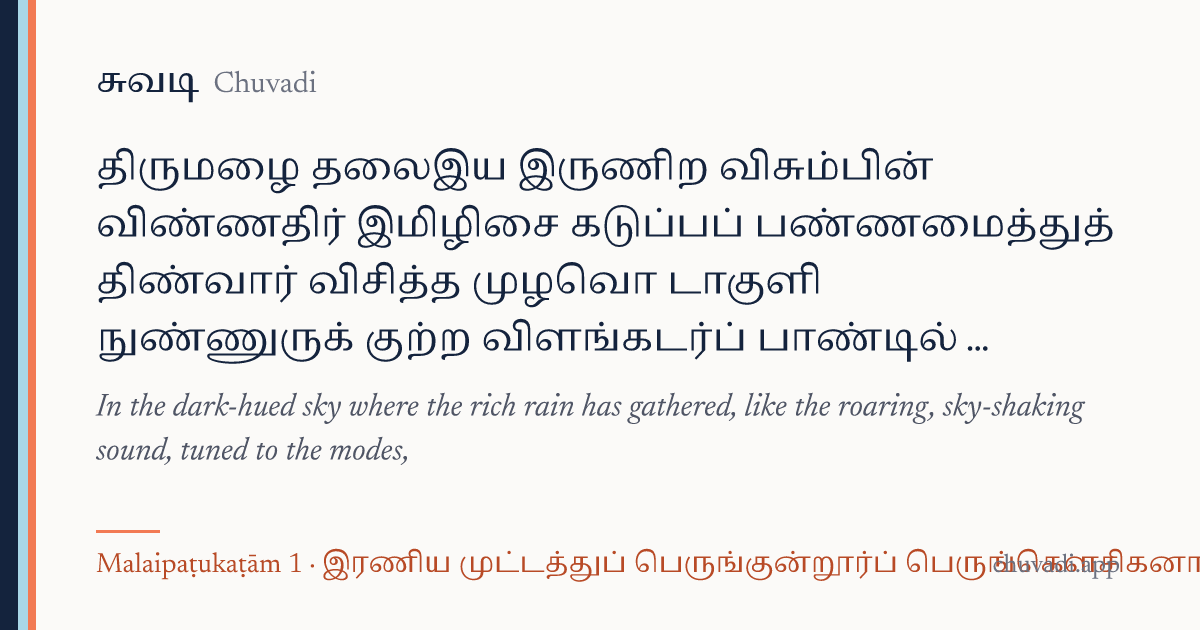
- In the dark-hued sky where the rich rain has gathered,
- like the roaring, sky-shaking sound, tuned to the modes,
- the muḻavu drum laced with strong straps, the ākuḷi drum,
- the bright pāṇṭil cymbals finely wrought in form,
- the horn adorned with a cluster of shining dark peacock feathers,
- the tūmpu that breathes like a bull elephant, holes made between its joints,
- the short and lovely tūmpu humming in the iḷi note,
- the sweet flute that takes up the calling note, all packed together,
- the taṭṭai with its rattling voice that sounds in the middle,
- the hard-mouthed ellari that rings out and seizes the ear,
- the patalai that gives the snap of the beat, and others too,
- like the clusters of young fruit on a jackfruit tree heavy in the rains,
- you, with your kalappai bags on carrying poles, bound in even loads,
- on the wide mountain that rose with a fierce clamour,
- beside rocks that seem laid down flat,
- on narrow paths hard to tread, as if lifted and set upright,
- where hill-men with arrows fitted, joined with their companions,
- lead travellers on without doing them harm,
- on top of the ridge, heedless of the hard places,
- you who keep to the way across the heights of the thundering wilds,
- with tivavu bands set in rings like twisted bangles,
- never leaving the heard pitch even by a mustard seed,
- with strings of fine twisted fibre, strung after testing the note,
- rubbed until all roughness is gone, and, like the ear of millet
- stripped clean, fine holes set in,
- the resonant pattal body joined fast with glue,
- pegs driven in to fill the shining holes,
- its white-handled binding newly made,
- its gold-like hide newly stretched over it,
- like a young woman whose five-part hair, fragrant to bees,
- smells of the wedding, on whose fine, swaying, lovely body
- runs the beautiful line of soft hair, so it lies
- joined closely to the belly, not straying from its measure,
- the end of the bowl arching away, held where it forks,
- dark of hue and smooth, polished by a fine file,
- with a gleaming, glowing form like the kaḷam fruit,
- the great yāḻ of rich voice with its curving, upraised neck,
- tuned to fit, not straying from the gentle way,
- fit for the royal court with its famed fortune,
- with the pāṇar who have mastered many modes, their distress gone,
- since they climbed the tall, soaring great mountain without harm,
- like the tongue of a hound whose fierceness is spent,
- their small feet, struck by stones, weary in their swaying gait,
- letting their hair fall loose like a flock of peacocks, resting,
- with red-lined eyes that spread wide across the face,
- the viṟaliyar with shining bangles gathering around you,
- in the cool, kindly shade, as if one had entered a pool,
- on the forest edge with sand spread where the stream washed it,
- resting, your weariness put away, a fresh sight to see,
- O leader of the kin of kaṇṇuḷar who win rich ornaments!
- Swollen high, crowded with clean flowers, beating at its banks,
- as a good river from on high spreads out to the sea, just so
- we come from him. You too,
- to eat with their kin in a forest dropping with fruit,
- like a flock of birds that soar on swift wings,
- to the one whose chest, where bees swarm, is splendid with a woven garland,
- with beautiful breasts painted with designs and arms rounded like bent bamboo,
- husband of women with cool, flower-like eyes,
- of unapproachable strength that lays the enemy frontier waste,
- who, to the ploughmen whose plough is longing and whose seed is the telling of fame,
- is gentle like the water that comes in a fresh flood,
- of wise counsel that knows the good and never weighs a change of mind,
- with large hands skilled in the bow and great ornaments he loves to wear,
- to Naṉṉaṉ, son of Naṉṉaṉ, with the resolve to go to him,
- if you go with him in your thoughts, then, meeting the hour,
- you are surely the birds of good omen; since you have met me,
- the measure of the road, the good lands where you may rest,
- the food of his land, where wealth flows in every place,
- the mountains, the groves, the forests that animals love,
- his good fame that does not perish but stands with the world,
- how he sees the backs of many and brings their rare jewels
- and pours them for poets, his rain of giving,
- his strength that binds those who scorn him, and for those who praise him
- a gaze not content even if he gave away his whole kingdom;
- like the unfailing sky that has poured down pure drops,
- his daily seat of joy that flows on without ceasing;
- in the assembly of skilled tongues where good men gather,
- those who came, even if unskilled, his men cover from behind,
- speak for them, show them the way, explain without flagging,
- and guide them well: the conduct of his retinue;
- of fierce and fearful strength that chills the waters within,
- who dwells, loving it, on Naviram of great renown:
- the nature of the god who ate the dark poison;
- so that the spreading darkness leaves, making day, rising
- like the sun: his blameless excellence;
- who, though those times are long past, crossed the enemies' lands
- to bring them under the yoke, slaughtered them in battle,
- and in the camp walled with tall shields, in the shade of spears, to the poets
- paid in full the debt of giving: the descent of his ancestors;
- with crooked-legged crocodiles that move about seeking prey,
- its moat dug into rock, deep so that waves ripple,
- and its sky-touching rampart rising high like the hills,
- the nature of the ancient city of him who filled it so its fame travels far:
- hear all these now; and the quarter where you go seeking the Vēḷ:
- In its settlements rich with new yield, where great plenty has ripened,
- this is what has newly come, this is its nature.
- The sky flashed with lightning and poured in torrents without stopping,
- so all that was sown grew as was wished;
- in the wide, dark fields that lay soaked with rain,
- like the stars in the broad, dark sky,
- the slender creeper mucuṇṭai spread its white blossoms;
- beside the sown fields that look like indigo,
- since the plentiful drops embraced them and no blight spread,
- in the forest tracts with springs as full as great vats,
- free of disease, the black pods, seven to a handful,
- filled with oil: the many-branched, moist sesame;
- like the clasping trunk of an elephant calf that struggles in a pit-trap,
- the millet with curving heads has reached the stage for plucking;
- at every pod cluster, as the flowers fall like flecks of set curd,
- the avarai beans have borne curved pods like the kuḷir;
- in the great fields where rocks stand out like buffaloes,
- their forked ears bowed like a vātikai,
- the varaku has come under the iron sickle;
- filled with milk, many-stalked, split by the wind,
- the white aivaṉam rice has ripened brightly;
- as if a spear-crowded troop had broken and fled,
- the canes, crushed by the wind, bowed with drooping heads,
- grown so high that cutting cannot reach them, laid on the rock,
- the sweet sugarcane whirls in the press;
- in the flower-filled forest, past the freshness of the rain,
- the tōrai with its lovely sheaths has reached the stage for pounding;
- in the hoed plots sown without fail,
- in the white-stemmed fields crowded with mustard,
- the tall fragrant neytal has spread like darkness;
- the root that no one shaped grew and came to its full beauty,
- and the ginger and the great root have taken on their sharpness;
- like the knees of a pregnant she-elephant, in every hollow
- the kavalai yams with their lush vines have settled deep;
- as if a thick-shafted spear had leapt at a tusker's face,
- the bud left after the flowers have opened in turn touches the raised tip,
- and the grove's plantains that ring the boulders
- have ripened their tight bunches hard; in that sweetness,
- on the wide rock where the ripe untūḻ bamboo sways,
- because the trees give fruit even out of season,
- the black fruits of the nāval have fallen in the wind;
- the uyavai with its welling sap has spread in rivalry;
- the kūvai has gathered with its flour; with its pulp excelling,
- the sweet mango has stopped those who eat it; splitting its rind,
- the tall-trunked āciṉi has shed its seeds;
- like the ākuḷi drum whose eye is pressed by the finger,
- on the slopes of the tall mountain where the owl calls,
- bearing fruit below and above, ripened in the rains,
- hanging like the drums of the kōṭiyar who travel by hidden ways,
- the jackfruit with swaying branches has bowed with age;
- the bright red kāntaḷ, like fire,
- its new buds sprung up in the spray, which, taking them for meat,
- the dull-backed cock picked up without knowing,
- and since they were not meat, dropped uneaten;
- its many petals, like fire, lie strewn
- on every broad rock that looks like a ground for the veṟi dance,
- on the great mountain's slope, fragrant like a wedding house.
- There, with honey, with tubers, with baskets full of meat,
- who drive off the harm of the small-eyed boar,
- with the tusks of an elephant that fought and fell for a carrying pole,
- the hill-men whose shoulder-poles are heavy with flesh:
- if you reach their small village of rich and plentiful new yield,
- you with your large, great family will get food in plenty.
- Rest there that day, stay when night comes on,
- and wearing with your troupe bright clusters, glowing like fire,
- of the red ceyalai, go along the even path;
- in the āri ravine where swaying bamboos creak,
- when you reach the hamlet set close against the mountain,
- if you say, We are bards of the strong-footed one, victorious
- in battle no foe can bear, the proud and mighty Vēḷ,
- you will not stand waiting but walk in as into your own houses,
- and mingle with them unasked, as if you were their kin;
- they will speak sweet words so that your sorrow for far lands goes,
- and with a stew of fat in which thick chunks were poured
- you will get heaps of bright-grained iṟaṭi millet;
- with the riches of the shining mountain that they climb for and bring,
- the clear honey-liquor ripened in bamboo
- you will drink without stint, delighting in toddy, and at dawn,
- so that your drowsiness from last night's drinking clears,
- white seeds of old broken fruit that the waterfall brought down,
- rich cuts of a sambar deer whose rushing charge was stopped,
- split slices of green fat from a porcupine that was killed,
- mixed with meat that the bitch hounds ran down,
- and with the fruit with tufted tops that holds white flesh,
- its sweet sourness blended in to make a dark buttermilk,
- rice of the bamboo boiled and cooked in the pot,
- stirred so that the slope where vaḻai trees grow is fragrant,
- she of fragrant dark hair adorned with sweet flowers,
- the kuṟa woman, has made white, well-opened food;
- served with eagerness and the joy that fills the heart,
- holding you back as if you were their own kin, you will get it in every house.
- So that you forget the gift you set out for from the lord
- of warring strength, you may well linger long.
- But his country on the mountain is not like that alone:
- even if you touch the fragrant bloom of the row-petalled kuvaḷai,
- even if you see the seat of the goddesses of the mountain,
- you may well burn and shiver as if your life were leaving.
- Do not stay many days; go on to the lowland country.
- Because the ripe fields were being ravaged, fearing the boar,
- they have set big-stone traps at every gap,
- so the paths have hidden devices; in the dead of night
- stay where you are, and go on at dawn when the alari opens.
- If you choose a path dense with growth that few travel,
- where the gravelly hard ground has split open in clefts,
- there are pits as well where snakes hide and lie low;
- mark them well, strike the trees, look about,
- and with your viṟaliyar of close-set bangles worshipping with joined hands and praising,
- step a little off the path, keep them on your right, and go on.
- The kuṟavar who guard the fields past their first growth, vexed,
- climb the high-standing watch platform and clap their hands;
- to stop the daytime stay of elephants crowding the thickets of the broad mountain,
- the hard stone that the sling spits out
- bounds off the wet stems of the dark bamboo, so that with a crash
- the black-fingered langurs scatter with their young;
- that stone, like Death whose way is to destroy life,
- does not slacken its coming speed; go on with the trees for cover.
- Where crocodiles that hide away even mighty bulls lurk
- in a place where darkness hangs as at night,
- in the narrow gorge of the deep pool where bubbles whirl,
- the forest river's crossing is like going down into a moat;
- it has slippery edges, so guard against slipping,
- hold the trunk that thick creepers have wound about,
- and with your children whose thin-haired heads are like lambs',
- one by one, one by one, take care and go on.
- On the slope thick with puḻaku, where feet sink and stumble,
- near the deep pools that drown those who fall in,
- where fine-watered moss hides the surface with slime
- and there are treacherous spots that loosen your footing,
- with the thin-stemmed vēral bamboo tangled along the whole path,
- take hold of the soft stalks of eruvai reed and pass on.
- So that the spotted faces of the high-standing great rocks are hidden,
- there are fierce arrows that bows spit out, falling like rain;
- elephants trained in war-work, splendid with garlands;
- a pool of bright flowers, splendid as an elephant's brow-ornament;
- an ancient walled fort by the course of a lone river;
- if you see a god whose tradition is worthy of praise,
- pass on worshipping; apart from that, idly
- take care not to touch your instruments. Mingled drops
- of rain pour down on his rich mountain.
- Even if the peacock, its plumes with white quills like alakai,
- its train spread, falters in its forest haunt;
- even if the male monkey, like the children of kōṭiyar with loud drums,
- leaps about the branches of the tall bamboo;
- ranged like a wheel along the straight, towering cliff,
- even if you see honeycombs on slopes where the Cūr spirits love to dwell,
- take care not to stare at them suddenly; it is not fitting.
- You whose soft feet walk in a line will lose your way
- if you stray into the forest on tracks that lead to the hills.
- If, having gone off with the arrow of the far watcher on his platform,
- swollen with white fat like ghee,
- its chest wound deepening, its tusks that dig the earth,
- its great rough-bristled neck, lying so the path is blocked,
- you see a boar like a slab cut out of darkness,
- in a fire of the forest kindled by dry bamboos rubbing together,
- roast it so the dense smoke does not reek, and eat it;
- water clear as a sapphire, utterly free of dust,
- from the cool green pool with kuvaḷai drink until your weariness leaves;
- you, with bundles of thick pieces, having taken food in plenty,
- together with your scant-haired boys whose hunger is gone,
- take care not to go on in the night; fully at ease,
- as though entering your own home, stay in the rock caves.
- Lodge when night comes and guard against weariness,
- rise to meet the dawn spreading wide across the sky,
- and take the straight path that runs through the forest.
- With a wide maw like a pool and lovely eyes,
- crushing the strength of the bull elephant full of might and rage,
- the python like a sleeping log: turn aside from it;
- flowers that pass all bounds and spread their scent far off; fruits that leave those who ate them
- unable to stop forgetting; and though, past ripeness,
- their great yield goes to waste, men do not go near them;
- groves of great trees that shed blossom from dark trunks;
- thinking on them, look to the left and to the right,
- know the signs, and pass on without coming near any of these.
- In the fruiting banyan with many branches grown old,
- like an ensemble of instruments played together, the birds join their voices;
- through the wide space where the land opens to view, move off slowly.
- In the thicket thick with trees under deep shade,
- in the vast dim space where the sun does not scorch,
- even at a time when you are bewildered about direction,
- even those with strong bows, who roam about seeking game,
- the kuṟavar, lose their way: if you come into such hills,
- do not crowd onto the wide rocks and with a clamour
- walk about: take care, and play your instruments.
- On the rich heights of the resounding waterfalls
- there are hill-men who dwell guarding the forest.
- For people who lost their strength, having slipped from a steady ford, they
- come quickly at the outcry of those caught in the stream;
- fruits sweet to eat, and, sweet for those who see them
- to wear, flowers too they show you,
- and going before you on the path full of perils,
- so that the grief in your hearts comes to an end;
- swiftly, with your troupe, you will be glad again.
- Taking the direction that those who know have told,
- on slopes short and tall descending in turn, where newcomers
- tremble even to look, on the slope full of hardship,
- if you sit and rest in the dappled shade strewn with blossom,
- you will hear sounds that move in many ways.
- As the great fruit bitten by the stag oozes from its wound,
- the whole mountain is fragrant; in every quarter of it
- the sky-maidens who delight in the waterfalls
- plunge in without checking the falling force, and each time they bathe
- comes a sweet sound like your instruments tuned to chosen notes;
- the lone tusker with shining upraised tusks, strayed from its herd,
- and on the platforms high on the hill the hill-men,
- as it enters the lonely field to feed, raise the clamour of spiral conches;
- the porcupine lying in its den far off, with quills like spears,
- shoots, and the hill-men who slip and fall cry out;
- because the curved-striped tiger sprang upon their husbands' chests,
- to soothe the long deep gash of the wound, as a guarding charm,
- the song of the hill-women whose tresses are like dark sand-ripples;
- for the vēṅkai with golden clusters that bloomed on the first day,
- the loud cry they raise so they can wear its flowers;
- the soft-headed young cow-elephant whose calf has fallen into a rock-hole
- is guarded by her mate, who is the very limit of strength,
- and when the bright-hued mighty tiger springs, with all the herd
- the thunder-spewing roar that echoes over the tall hill;
- the black-fingered she-monkey that forgot to keep her grip,
- her unskilled young having fallen into a hard cleft,
- crowds with her kin, whose bodies feed on tender shoots,
- in a clamour of grief that will not cease;
- on the tall hill whose sight leaves even the stag helpless,
- setting up ladders and making them the path,
- the honey-plunder that gathered great yield,
- the joy of the hill-men who broke the hard fortress of the hive;
- saying it will be fit as a feast-offering for the lord of the polished spear,
- the kuṟavar who brewed the toddy that day, with their women,
- while the small deer-skin drums sound, loudly
- dance the kuravai on the peak that touches the sky;
- as if a tall chariot of fine beauty were coming down the road,
- the rocky river roars, and the clefts echo its sound;
- the fierce-eyed elephant caught in a deep long pit,
- to calm its mighty anger and tie it to a great post,
- the voices of the mahouts who keep speaking a mixed tongue;
- in every field where they beat the rattling bamboo clappers,
- the calling cries of the girls who chase away the parrots;
- a fine bull with swaying hump, parted from its herd,
- and the swift bull of the wild cow that came to the hilltop
- clash, wounding each other with unyielding strength,
- while the cowherds and the kuṟavar shout together,
- and the wide-petalled kuḷavi and the kuṟiñci are crushed:
- the loud tumult of the fine bulls fighting;
- swinging the fragrant stalk of kāntaḷ from the thicket,
- the sweet ripe pods of the strong-branched jackfruit;
- eating them, and to take the seeds from what is left over,
- the shout of the boys who drive the calves away;
- at every press, where steam rises like clouds, suddenly
- the canes crack open at the joints, the sound of the sugarcane mills;
- the vaḷḷai song of the women who pound the millet;
- the guards who watch over the cēmpu and the turmeric
- beat the boar-drum, and the echoes ring in the hills:
- all these, joined and gathered together,
- crowding the hollows and the heights, many at once,
- past all reckoning, of kinds beyond counting,
- the roar born of the mountain resounds in every quarter;
- with women who wear garlands of bright colours,
- in the wide open grounds where the muḻavu never sleeps,
- like a festival is his broad mountain.
- Seeing and hearing what is cool to the eye,
- praising the many things sweet to eat,
- saying, may this come to us again,
- keeping to the custom of old; the man of many glories,
- whose chest bears fortune, who delights in excelling in battle:
- when his great mountain, with thundering clouds, is behind you,
- with your sweet-voiced viṟaliyar filled with wonder,
- singing kuṟiñci on the fragrant cloudy slope,
- worship with joined hands, praise him, and go on.
- Over the great dark mountain, billowing like carded cotton,
- a band of rain clouds low enough to touch by hand
- scatters spray as if strewn, and so,
- with your quick-stepping troupe who cannot tell the way,
- so that the instruments you have guarded do not slacken,
- enter the clefts in the rock that are like wells.
- Do not go near the broken cliffs where great boulders roll down;
- in the vast hard passages where the hills close in,
- even if you stop and look, your eyes are robbed of their light;
- take the head-staff of your drum, its face packed with clay paste,
- and with it for a walking stick, guard yourselves from stumbling;
- lean on it and pass on, for the dangers there are very many.
- Rock slabs with stones as sharp as heated spear-points
- throw back the sun's heat on that painful track:
- pass on at the hour when the rays have softened their fury.
- With his kin, who never leave him, he whose fame has spread wide
- has many shields, high beyond compare, like clouds,
- and strongholds that break the standing of kings.
- At every opening in the thickets tangled as if plaited,
- the bough pulled back by the man in front swings with an arrow's force;
- so the sweet-toned bowl of your good yāḻ and the tight-laced
- eye of your drum smeared with clay: guard them,
- and never loosening your hands' grip, pass on slowly.
- Boulders crowded close like bull elephants locked in fight
- and forests where the dew drips are many, beyond measure.
- Because they roared where hostile enemies were crushed,
- proud warriors who gave themselves in the good way
- have stones set up with their names and their unfading fame;
- the forks of paths where such stones stand are too many to count.
- Let your song with its delightful rhythm be their pleasure;
- by the custom long handed down, stroke the yāḻ's stem, and hurry on.
- You are newcomers, who left your own land and never knew this one:
- clear the junctions of the paths and knot the grass as you go.
- So that travellers may know the names of the places they go to,
- letters are cut with stones on the good trunk of the marā tree,
- and the forest forks where the god stands high,
- even hostile enemies, who would not yield and went far,
- shudder when the dry tracts are only named: these are very many.
- If you say: we go to the patron whose garland drips honey, whose giving hand
- flings away chariots, the patron who never holds back,
- then his ancient town of old lineage, rich beyond all,
- is like that, indeed, for people such as we.
- Rest where you grow tired, and pass on without fear.
- Thinking of his beloved doe, who was struck with dread when the tiger came,
- the stag stands and calls in the forest; going past it in turn,
- where the red-eyed marai bull, frightened by the bow's twang,
- rushes off with lowered head through the woodland of fragrant creepers,
- with herds that have gone off to other pastures, with their bulls,
- the cowherds amid the thickets, with the sweet milk of curved-horned cows,
- bring it and pour it out, so that the bangled women rejoice;
- you who left your town with the desire to gain rewards
- will have your loneliness driven far, and you will be made new.
- Like the many streaks of mixed paddy brought for barter,
- rams mixed with turuvai ewes and with white goats
- crowd the noisy wilderness and roar like the sea:
- if you come at nightfall among those many flocks of sheep,
- you will get milk and gruel without any trouble.
- Like a bed stuffed with soft fleece,
- on a bed of hides, stripped from the body and trampled flat,
- rest with the fire for your companion, and then pass on.
- With sharp good arrows that fly farther than a shout carries,
- if you see the band of kūḷiyar with their curved bows,
- and you say: we go to the husband of the creeper-like lady,
- whose unbending manhood has worn down those who opposed him,
- they will bring you meat and roots that they have gathered;
- they will protect you; there are none who will harm you.
- Take your way there; that is the nature of the place.
- The soft clusters of marā that have opened so that honey flows,
- and all the bright shoots that sprang where elephants broke the boughs,
- woven with tender leaves into a lovely garland:
- wear it, so that it gleams, tied with fibre from a withered tree.
- On the path where the hard gravel ground has broken open, the water is cool:
- drink, bathe, take some with you, and pass on.
- Like the flowers of the red-blossomed vēṅkai,
- gruel of bamboo rice, poured out,
- with paddy grown on the high ground and fresh porridge of avarai beans,
- so that your weariness from struggling through the night may end,
- in the wide open space, built of poles woven together,
- in every household of the grass-thatched huts you will receive.
- Fine and lovely rice, like beaten gold,
- a dark-crusted ball of rice made with white butter tossed in,
- with cool, smooth ghee as what is put inside it,
- if you rest and stay, you will receive each night.
- Like the powder sifted from sugar,
- fine-ground nuvaṇai flour that holds back those who eat it,
- kindling a blaze from brittle, light firewood,
- so the cold goes far off, sleep sweetly all together,
- and at the break of dawn, heeding the birds, go on.
- At the sluices where the water strikes the thin-trunked kāñci,
- in every village set in the soft low fields, like a good yāḻ
- changing from one paṇ to another, groves and resting places,
- whether you stay many days or go on after resting,
- his cool land of fields holds many good things.
- Stirring the fields thick with kaṇpu reeds till they give off their smell,
- the dark-backed vāḷai that the net-men brought,
- caught on the long-lined hooks set by those who stand and wait,
- the red-eyed varāl, like a cow elephant's trunk,
- mixing these with chunks like the face of a tuṭi drum,
- the women of the paḻaiyar, wearing pakaṉṟai garlands;
- in fields where crabs play, where the grain was spread out,
- having threshed the stacks that stand like hills,
- as the workers who make wealth give their food,
- clear toddy from green bundles, poured from swaying jars,
- you will receive at every threshing floor in the young-rayed sun.
- White rice with veḷḷari cucumber pared of its prickles,
- whose garland drips honey and smells so that bees settle,
- that, people say, is a meal fit even for Naṉṉaṉ of the sturdy chariot,
- eating with your troupe while those who see you marvel,
- with the shouts of the field-hands who drive the bulls, tune the good yāḻ
- to marutam, rest, and go on.
- Frightened by the taṇṇumai drum of the reapers of white paddy,
- a red-eyed buffalo bull, strayed from its herd,
- may charge with heavy-paced force: guard against its rush.
- Where eddies whirl like a potter's wheel
- at its swift head, roaring without pause,
- of the Cēyāṟu with its deep pools that viewers long to see,
- keep to its one rich bank and go on.
- In the high-rising walled town where treasure sleeps,
- with old families that never left their homes living together,
- in the great splendid market place whose wide space is not enough,
- in streets that lie like rivers, festive like a festival,
- in branching lanes that those who scorn him fear,
- with a din that roars like the sea, like the thunder cloud,
- the mansions rising like mountains, like clouds,
- where people live gladly in love that knows no quarrel,
- with cool dewy groves where many bees hum,
- his ancient town of old valour is not very far.
- So that the great heads of hostile foes are cut off,
- warriors with bright swords who win so that kites gather;
- at the gate where black-butted spears lean on the doors,
- through the strongly guarded entrance, go in without doubt.
- Saying, those who stay in the courtyard are suppliants from distant lands,
- who thought of the great valour of the young lord, victorious in war,
- those who came are surely to be pitied,
- all who see you will look on you kindly and sweetly,
- each of them will receive you as guests, and you will draw near;
- so that the weariness that wandering in lonely lands gave you may end,
- from the marā tree whose flowering branches look like spat-out fire,
- when its herd had gone, caught by force,
- the soft-gaited āmāṉ, the elephant calf,
- the curved-pawed cub of the mute bear,
- the high-dwelling, swift-leaping, crook-legged
- varuṭai that lives on the rocks, the great hard-headed ram,
- the small-eyed tīrvai that raids the strongholds of snakes,
- that dreaded being seized by the tiger lurking in its den,
- the large-eared calf of the soft-eyed marai deer,
- on red ground like spread-out lac,
- the crook-legged male monitor lizard crawling on the gravel,
- the soft-eyed peacock that moves, adorning the hills,
- the cock of the jungle fowl with its forked cry,
- the great fruit of the forest jackfruit, like a drum,
- of the mango whose fragrant young fruit is like a mix of pounded flour,
- sweet ripe fruit whose strained pulp has ripened into syrup,
- growing creepers with climbing buds that flourished in the spray,
- nūṟai yams carried on a shoulder-pole, like a yoke,
- many fine gems shed from thick crystal,
- from the elephant, full of wounds, that fought the coloured tiger,
- tusks holding pearls, of full strength, very thick,
- kāntaḷ with broad petals like a broken conch bangle,
- nākam and tilakam, sandal with fragrant heartwood,
- green pepper in clusters of berries from the black pepper vine,
- clear toddy of honey, finely matured,
- sweet curd poured into bamboo, from buffalo that stay in the forest,
- which, when the dark-blue ōri leapt on it, from the tall cliff
- rolled like a wheel: the honeycomb with rich cells,
- āciṉi fruit gathered together with all these, all of it,
- like the cool great Kāviri, born in the western hills,
- at its broad mouth where it rushes into the expanse of the sea,
- crowding at the tall gate of him whose war no foe can bear,
- with rich elephants, many as the clouds of the sky,
- go towards the courtyard thick with their pollen-like dung;
- while the eyes of the drums sound, answering the rain clouds,
- while the holes of the pipe made of grown bamboo hum,
- the small yāḻ with black neck, tuned to marutam,
- not straying beyond its strings, joining in one with them,
- viṟaliyar of sweet voice who know what they must do,
- not failing their own nature, in the custom followed from of old,
- after they praise the god of rare power,
- and finish a new song, then with long-reaching words,
- 'Descendant of those gone before, whose good fame does not wane,
- so that their fame stays with the world and does not pass from here today,
- now that the great ones who saw men's need and knew it are dead,
- O noble one, who has paid the debt of giving,'
- praise him, his many fames of victory and his might;
- he will not let you even tell of your journey: 'Desire brought you,
- your coming is enough, your hardship too is great,' he will say;
- shining among warriors who meet the clash of battle,
- he will want you to come near the courtyard of his fine palace,
- and will seat your noisy kin at his good right side.
- Of high thrones, with kin free of harshness,
- of wide inheritance, of keen and subtle wisdom,
- who spread their open hands and said 'we have nothing',
- those who died and took their names away with them
- outnumber, in the river whose waterfalls come down the tall hills in full flood,
- the swift-running muddy stream, the Cēyāṟu pleasing to the eye,
- the sand of its dunes where ripples lie: so many are they;
- therefore, 'Let our allotted days pass with fame,' he thinks,
- and with a sky-touching heart that gives widely,
- more than you who came in desire, he himself, greatly
- glad of heart, will look at you kindly and with pleasure,
- and garments of fine thread, whose threads cannot be told apart,
- faultless in excellence, he will put around your bare waists;
- with pieces of fresh fat meat that the hound brought,
- and rice of long white paddy, without stint,
- with welcome as on the first day, growing greater as days pass,
- you will receive, even if you stay many days. 'Not staying,
- we must go, returning to our old home,' so
- if you say gently and ask leave, to the leader among you
- he will give a golden lotus to wear, and to the viṟaliyar
- bright jewels of glorious excellence to wear;
- tall chariots that move in rows like the flow of water,
- hill-like elephants that no pen can hold,
- great herds with bulls, where loud bells clang,
- horses with clipped manes, shining in golden harness,
- and treasure that lay long for the earth to eat, all of these,
- so that the receiving hands of poets fallen into want are filled,
- with his large hand, with loose bracelet, turned down to pour out gifts,
- never failing in his wealth, rich in true words,
- suddenly, as on the summit of Naviram where bamboo grows
- the rain pours down, he will give his gifts
- and send you off on the first day with them; he whose mountain streams
- appear like banners raised in victory,
- the lord of the land with dwellings ringed by hills.
What the poem says
Malaipaṭukaṭām, "the roar that rises from the mountain", is the longest of the āṟṟuppaṭai or guide poems in the Pattuppāṭṭu. Its 583 lines are spoken by a kūttaṉ, the leader of a troupe of dancers and musicians, who has already been rewarded by the chieftain Naṉṉaṉ, son of Naṉṉaṉ. He meets another troupe resting on the road and tells them how to reach the same patron through the hills, what they will meet on the way, and how they will be received. The poet is Peruṅkuṉṟūrp Peruṅkeḷacikaṉār of Iraṇiya Muṭṭam; the patron is Naṉṉaṉ Vēṇmāṉ, lord of the hill country around Naviram.
Lines 1 to 50 picture the troupe on the mountain path: the drums, horns, pipes and clappers packed in their bags on carrying poles, and above all the great yāḻ, described part by part, with its skin cover compared to the hair-line on a young bride's belly (lines 21 to 37). The speaker hails their leader in line 50, says he comes from Naṉṉaṉ like a river running to the sea, and promises to tell them everything: the road, the god on Naviram, the king's ancestry, his town and his gifts (lines 51 to 94).
The long middle of the poem is the journey itself. Lines 95 to 151 list the crops of the hill fields as the season comes in: sesame, millet, beans, rice, sugarcane, ginger, yams, plantains, jackfruit and mango. Then come the hamlets of the hill-men and the kuṟavar, where the travellers are fed with meat, honey liquor and bamboo rice (lines 152 to 187), followed by warnings: boar traps, snake pits, sling stones aimed at elephants, crocodile pools, slippery moss, wild beasts and spirit-haunted slopes (lines 188 to 286). Lines 287 to 351 give the passage that names the poem: sitting in the shade, the travellers will hear the many sounds of the mountain at once, the bathing of sky-maidens, conches, the cries of fallen hunters, women singing charms over a tiger wound, bull-fights, the vaḷḷai song of millet pounders, until the whole mountain sounds like a festival.
From line 352 the route comes down. The troupe passes hero stones and forest shrines (lines 384 to 398), the camps of herders and goatherds (lines 403 to 420), the kūḷiyar bowmen (lines 421 to 427), and then the farmland, where they will be given rice, fish, cucumber and toddy at the threshing floors (lines 449 to 470). They follow a bank of the Cēyāṟu and reach Naṉṉaṉ's old town, with its markets, mansions and guarded gate (lines 471 to 491).
The last section (lines 492 to 583) is the reception. Townspeople welcome the strangers. At the palace gate the produce of the hills is piled up, compared to the Kāviri crowding into the sea at its mouth (lines 497 to 531). The viṟaliyar praise first the god and then the king, who will not even let them tell of the journey. He reflects that the rulers who had thrones and wealth yet showed empty hands, saying they had nothing, died and took their names with them, and that they outnumber the grains of sand on the Cēyāṟu; so he wants his own days to pass in fame (lines 550 to 557). He clothes the troupe, feeds them for as long as they stay, and when they ask to leave he gives a golden lotus to the leader, jewels to the women, and chariots, elephants, cattle, horses and treasure, pouring like rain on Naviram.
Naviram is the hill where the god who ate the dark poison, that is Śiva, is said to dwell (lines 81 to 83), and Naṉṉaṉ's country lies on the Cēyāṟu. Some words name plants, animals and instruments that cannot be identified for certain: the tīrvai of line 504 (perhaps a mongoose), the vātikai of line 112, and the kuḷir of line 110. The lines on the ancestors' feasts (86 to 89), the hazards and shields of lines 376 to 378, the rescuers of lines 280 to 284, and the gifts carried at lines 498 to 506 are compressed, and their syntax can be read in more than one way.