



நெடுநல்வாடை 1
பாடல் · The poem
Tap a word to see where else it occurs.
பொருள் · Meaning in TamilAI
வாடைக் காற்று வீசும் கூதிர்க் காலம். உலகம் நடுங்க, மேகங்கள் வலமாக எழுந்து சூழ்ந்து, தவறாத வானம் புதிய மழையைப் பொழிந்தது. பெருமழையை வெறுத்த, வளைந்த கோல் ஏந்திய இடையர்கள் காளைகளுடன் கூடிய தங்கள் ஆநிரைகளை வேறு நிலங்களுக்குக் கொண்டு சென்றனர். தம் ஊரைப் பிரிந்த தனிமையால் கலங்கி, காந்தள் மாலை நீரில் நனைந்து கலைய, உடலைப் பற்றும் கடுங்குளிர் வருத்த, பலரும் சேர்ந்து கையில் கொள்ளிக்கட்டைகளைப் பிடித்துக்கொண்டு தாடைகள் கிடுகிடுக்க நடுங்கினர். விலங்குகள் மேய மறந்தன; பெண் குரங்குகள் குளிரால் ஒடுங்கின; மரத்தில் தங்கும் பறவைகள் கீழே விழுந்தன; கறவைப் பசுக்கள் கன்றுகளைப் பால் குடிக்க விடாமல் உதைத்தன. மலையையே குளிரச் செய்வது போல வாடை கடுமையாக வீசியது. அது கூதிர்க் காலத்தின் நள்ளிரவு.
மெல்லிய கொடியான முசுண்டையின் புள்ளி கொண்ட வெண்பூக்களும், பொன் போன்ற பீர்க்கம் பூக்களும் புதர்தோறும் மலர்ந்தன. பச்சைக் கால்களும் மென்மையான சிறகுகளும் கொண்ட கொக்குக் கூட்டங்கள், கருஞ்சேறு பரவிய ஈர வெண்மணலில் சிவந்த வரிகள் கொண்ட நாரைகளுடன் சேர்ந்து எங்கும் இரையைப் பற்றின. வெள்ளம் குறைய, கயல் மீன்கள் நீரோட்டத்தை எதிர்த்துச் சென்றன. நீரைப் பொழிந்து முடித்து எழுந்த வெண்மேகங்கள் அகன்ற வானில் தூறல் தூவின. அகன்ற வயல்களில் மழையால் செழித்த நெற்பயிரின் கதிர்கள் வளைந்து தாழ்ந்தன. பாக்கு மரங்களின் நீலமணி போன்ற கழுத்தில் மடல் விரிந்த குலைகள் பருத்து, காய்கள் தெளிந்த நீர் நிறைந்து முற்றின. மலர்கள் நிறைந்த சோலைகளின் குளிர்ந்த கிளைகளில் நீர்த்துளிகள் தொங்கின.
மாடங்கள் உயர்ந்த வளமான பழைய நகரில், ஆறு போல் கிடக்கும் அகன்ற நீண்ட தெருக்களில், மாலை அணிந்த வலிய தோள்களும் முறுக்கேறிய உடலும் கொண்ட ஆடவர்கள் கள்ளைக் குடித்து மகிழ்ந்து, தூறலைப் பொருட்படுத்தாமல், பகல் கழிந்த பின்னும் இரு முனைகளும் தொங்கும் ஆடையுடன் விரும்பிய இடமெல்லாம் திரிந்தனர். வளையல் அணிந்த தோள்களும், மென்மையும், முத்துப் போன்ற புன்னகையும், குளிர்ந்த கண்களும் கொண்ட இளம்பெண்கள், கூடையில் வைத்திருந்த பிச்சி மொட்டுகள் மலர்ந்து மணம் வீசுவதைக் கொண்டு மாலை நேரம் வந்ததை அறிந்தனர். இரும்பு விளக்குகளில் திரியை ஏற்றி, நெல்லும் மலரும் தூவிக் கைகூப்பி வணங்கினர். கடைவீதி மாலை வழிபாட்டைச் செய்தது.
வீட்டில் வாழும் புறாவின் சிவந்த கால் கொண்ட சேவல், தன் பெடையுடன் முற்றத்தில் இரை தேடாமல், இரவும் பகலும் தெரியாமல் கலங்கி, உத்தரத்தில் இடம் மாறி மாறி அமர்ந்திருந்தது. காவல் மிக்க பெரிய மாளிகைகளில் பணியாளர்கள் நறுமணக் கல்லில் பலவகைக் கலவைகளை அரைத்தனர். வடநாட்டவர் கொண்டுவந்த சந்தனக் கல்லும், தென்னாட்டுச் சந்தனமும் பயன்படாமல் கிடந்தன. பெண்கள் கூந்தலில் மாலை சூடவில்லை; சில மலர்களையே சூடுவதற்காக, தகரம் என்னும் நறுமண மரத்தின் சுள்ளிகளால் நெருப்பு மூட்டி, அகிலோடும் வெள்ளை அயிரோடும் கூந்தலுக்குப் புகை ஊட்டினர். கைதேர்ந்த கைவினைஞன் அழகாகச் செய்த சிவந்த விசிறி மடக்கப்பட்டு, சிலந்தி வலை சுற்றிய முளையில் தொங்கியது. வானளாவிய மேல்மாடங்களில், தென்றல் வரும் வேனில் கால அறைகளின் சாளரங்கள் திறக்கப்படவில்லை; உறுதியான கதவுகள் தாழிட்டு மூடப்பட்டிருந்தன. தூறல் சத்தத்துடன் தூவியதால் யாரும் குடத்துக் குளிர்நீரைக் குடிக்கவில்லை. அகன்ற கணப்புகளில் நெருப்பு எரிந்தது. ஆடல் மகளிர் பாடலுக்கு இசை கூட்டுவதற்காக, குளிரால் சுருதி பிறழ்ந்த யாழ் நரம்புகளைத் தம் மார்பின் வெப்பத்தில் அணைத்துச் சூடேற்றி, சிறிய யாழைச் சுருதி சேர்த்தனர். காதலரைப் பிரிந்தவர்கள் வருந்தினர். மழை மிகுந்து கூதிர்க் காலம் நிலைபெற்றது.
அந்தக் காலத்தில், அரண்மனை கட்டப்பட்ட முறை இது. கதிர்களைப் பரப்பும் சூரியன் இரண்டு கோல்களின் நிழல் குறிக்கு விலகாமல், மேற்கிலோ கிழக்கிலோ சாயாமல் நிற்கும் நண்பகல் நேரத்தில், சிற்ப நூல் அறிந்த வல்லுநர்கள் நுட்பமாகக் கயிறு இட்டு அளந்து, திசைகளைக் குறித்து, தெய்வங்களை வணங்கி, பெரும்புகழ் மன்னருக்குத் தகுந்தபடி மனையை வகுத்தனர். உயர்ந்த மதில் சூழ்ந்த வளாகத்தில், பருத்த இரும்புப் பட்டைகள் பிணித்த, இணையாகப் பொருந்திய கதவுகள் அமைக்கப்பட்டன. அவை ஒரு விண்மீனின் பெயர் கொண்ட சிறந்த மரத்தால் ஆனவை; மலரும் குவளைப் பூ வடிவக் கைப்பிடி கொண்டவை; தாழ்ப்பாள் பொருந்த, இடைவெளி இல்லாமல் கைவினைஞன் இறுக்கிச் செய்தவை. வெண்கடுகு அப்பி நெய் பூசிய நெடிய நிலைகள் இருந்தன. வெற்றிக் கொடியுடன் யானை நுழையும் அளவுக்கு, மலையைக் குடைந்தது போல உயர்ந்த வாயில் இருந்தது. திருமகள் தங்கும், குற்றமற்ற சிறப்புடைய அந்த மாளிகையின் மணல் பரப்பிய முற்றத்தில், நீண்ட மயிர் கொண்ட வெண்ணிற ஆண் எகினம் குறுங்கால் அன்னங்களுடன் துள்ளி விளையாடியது. முன்வாயிலில், லாயத்தில் நின்று சலித்த பிடரி மயிர் கொண்ட குதிரைகள் புல்லை மென்று கனைத்தன. நிலா முற்றத்தில், கிம்புரி வடிவ வாய் கொண்ட குழாய்கள் நிறைந்து அருவி போல் மழைநீர் விழுந்தது. அதன் அருகே, நீண்ட தோகை அசைய, மயில்கள் கொம்பு இசை போல அகவின. மலைச்சாரல் போல அரண்மனை எதிரொலித்தது.
யவனர் செய்த பாவை விளக்குகளின் கையில் ஏந்திய அகலில் நெய் நிறைத்து, பருத்த திரி ஏற்றி, சுடர் குறையும்போதெல்லாம் தூண்டிவிட்டு, ஒவ்வொரு அறையிலும் இருள் நீக்கப்பட்டது. அரசனைத் தவிர வேறு ஆடவர் நெருங்க முடியாத காவல் மிக்க அந்தப்புரம் அது. மலை போன்ற மாடங்களில் வானவில் போலக் கொடிகள் பறந்தன. வெள்ளி போல் ஒளிரும் சாந்து பூசிய, நீலமணி போன்ற கரிய வலிய தூண்களும், செம்பால் செய்தது போன்ற நீண்ட சுவர்களும், பலவகைப் பூக்களின் ஓவியக் கொடியும் கொண்ட, ‘கரு’ என்ற சொல்லோடு பெயர் பெற்ற அழகிய பள்ளியறை அது.
நாற்பது ஆண்டு நிறைந்த, முரசு போன்ற வலிய கால்களும், அழகிய வரி நெற்றியும் கொண்ட, போரில் புகழ் பெற்று வீழ்ந்த யானையின் தந்தத்தை, அழகும் செம்மையும் பொருந்தச் செய்ய வல்ல கைவினைஞன் கூர்மையான உளியால் செதுக்கினான். அதன் கால்கள் இளம்பெண்களின் மார்பு போலப் பக்கங்களில் பருத்து, நடுவில் சிறுத்து, பூண்டு வடிவ அடிகளுடன் அமைந்தன. அந்தப் பெரிய கட்டிலைச் சுற்றி நுண்ணிய நூல் வேலைப்பாடும் முத்துச் சாளரங்களும் தொங்கவிடப்பட்டன. புலி வரி போன்ற பலகை பொருத்தப்பட்டது. அதன்மேல் பலநிற மயிர் கலந்து அடைத்த, வலிய விலங்கின் வேட்டைக் காட்சி வரைந்த விரிப்பு இருந்தது. காட்டில் முல்லை மலர்கள் கலந்தது போல் பூக்கள் வரிசையாகத் தூவப்பட்டன. துணையுடன் கூடும் அன்னத்தின் தூய வெண்ணிற இறகுகளால் ஆன இரண்டு தலையணைகளும் மெத்தையும் இடப்பட்டன. அதன் மேல் கஞ்சியிட்டுத் துவைத்த தூய மடிப்புத் துணி விரிக்கப்பட்டது.
அந்தப் படுக்கையில் அரசி இருக்கிறாள். முன்பு முத்தாரம் அணிந்த மார்பில் நீண்ட பின்னல் தொங்குகிறது. கணவனைப் பிரிந்ததால் அழகிய நெற்றியில் சில மெல்லிய மயிர்கள் உலர்ந்து கிடக்கின்றன. நீண்ட காதணிகளைக் கழற்றிவிட்டாள்; தாழ்ந்த காதில் சிறிய வளையம் மட்டும் உள்ளது. பொன் வளையல்கள் தேய்த்த முன்கையில் வலம்புரிச் சங்கு வளையும் காப்பு நூலும் மட்டுமே கட்டியுள்ளாள். வாளை மீனின் வாய் போல் வளைந்த மோதிரம் சிவந்த விரலில் உள்ளது. பூவேலைப் பட்டு அணிந்த இடையில் இப்போது அழுக்கேறிய ஆடை உள்ளது. வரையாத ஓவியம் போல் அலங்காரம் இல்லாமல் இருக்கிறாள். தளிர் போன்ற மேனியில் சுணங்கு பரந்த, மூங்கில் போன்ற மென்தோளும் அரும்பு போன்ற மார்பும் கச்சு இறுக்கிய வளைந்த இடையும் கொண்ட மென்மையான பணிப்பெண்கள் அவள் பாதங்களை வருடுகின்றனர். நரை கலந்த கூந்தல் கொண்ட செவிலியர்கள் கூடி, சிறியதும் பெரியதுமாகப் பல சொற்களைப் பேசி, ''உன் அன்புத் துணைவர் இப்போதே வருவார்'' என்று மகிழ்விக்கும் சொற்களைக் கூறுகின்றனர். அவள் அதை ஏற்காமல் மிகவும் அழுகிறாள். வலிய தூண்கள் தாங்கும், புதிதாக மெழுகு வண்ணம் தீட்டிய மேற்கட்டியில், மேட ராசியை முதலாகக் கொண்டு வானில் சுழலும் விண்மீன் வட்டத்தில், சிறப்பு மிக்க சந்திரனுடன் எப்போதும் இணைந்திருக்கும் உரோகிணியைப் பார்த்து ஏங்கி, நீண்ட பெருமூச்சு விடுகிறாள். இமைகளில் நிறைந்து விழும் கண்ணீரைச் சிவந்த விரலால் கடைக்கண்ணில் தொட்டுச் சுண்டி எறிகிறாள்.
தனிமையில் வாடும் இந்த அழகிய பெண்ணின் துன்பம் தீர, வெற்றி பெற்று விரைவில் முடிவதாக, அந்தப் போர் வேலை! அங்கே பாசறையில், ஒளிரும் முகபடாம் அணிந்த போர் யானைகள் தம் நீண்ட துதிக்கைகள் நிலத்தில் புரள வீழ்ந்துள்ளன. அந்த யானைகளைக் களத்தில் வீழ்த்திய வீரர்களின் வாள் புண்களைக் காண அரசன் வெளியே வருகிறான். வாடைக் காற்று வீசும்போதெல்லாம் அசைந்து தெற்கே சாயும் சுடர்களைக் கொண்ட விளக்குகள் எரிகின்றன. தலையில் வேம்பு கட்டிய வேலை ஏந்திய படைத்தலைவன் முன்னே சென்று வீரர்களை ஒவ்வொருவராகக் காட்டுகிறான். பின்னால் மணி கட்டிய பெண் யானையும், சேணம் கழற்றாத குதிரைகளும் சேற்றுத் தெருவில் தம் மேல் விழும் துளிகளை உதறுகின்றன. நழுவும் மேலாடையை இடக்கையால் பிடித்து, வாள் ஏந்திய இளம் வீரனின் தோளில் மற்றொரு கையை வைத்து, முகம் மலர்ந்து செல்கிறான். நூலால் மாலை கட்டிய வெண்குடை அசைந்து துளிகளை மறைக்கிறது. நள்ளிரவிலும் உறங்காமல் சிலருடன் திரிகிறான் அரசன். பலருடன் பகைத்து அவன் செய்யும் பாசறைப் போர் வேலை இதுவே.
திணை: வாகை. துறை: கூதிர்ப்பாசறை. செவிலியரின் ஆறுதல் சொற்களைத் தவிர இதில் யாரும் பேசுவதில்லை; புலவரே காட்சிகளை விவரிக்கிறார். இடையில் அரசியின் துன்பம் தீர அரசனின் போர் விரைவில் வெற்றியுடன் முடிய வேண்டும் என்று வேண்டுகிறார். பாடியவர் மதுரைக் கணக்காயனார் மகனார் நக்கீரர். வேம்பு பாண்டியரின் அடையாளம் என்பதால் பாட்டுடைத் தலைவன் ஒரு பாண்டிய மன்னன்; பாட்டில் அவன் பெயர் இல்லை.
ஆங்கிலம் · English translationAI
Translation
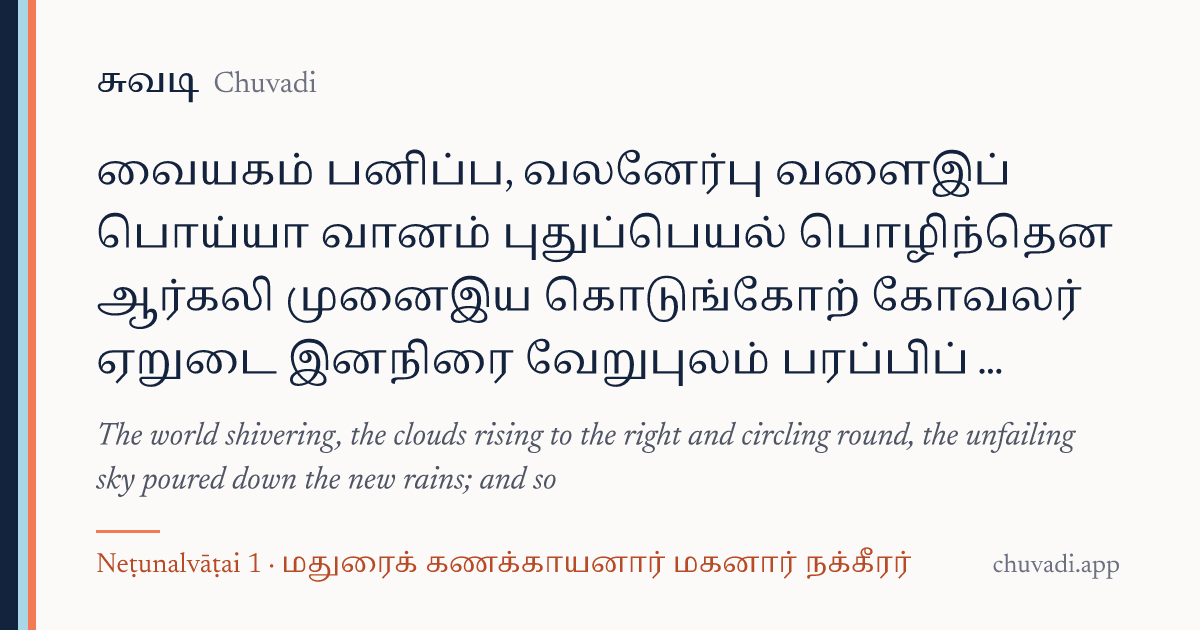
- The world shivering, the clouds rising to the right and circling round,
- the unfailing sky poured down the new rains; and so
- the herdsmen with crooked staffs, weary of the roaring downpour,
- drove their herds, bulls among them, to spread over other ground,
- and, troubled by the loneliness of leaving their own land, their garlands of kōṭal
- with long petals tossed and jumbled by the streaming water,
- as the great cold that seizes the body torments them, many together,
- holding firebrands in their hands, shiver with their jaws clattering;
- the beasts forget to graze, the female monkeys huddle in the cold,
- the birds that perch drop to the ground, the milch cows
- spurn their calves from the udder; blowing fiercely,
- in the midnight of the cold season, as if to chill the very hills,
- the white flowers of the slender mucuṇṭai creeper, spotted on their backs,
- bloom bush after bush along with the gold-like pīram;
- flocks of green-legged herons with soft wings,
- on the wet white sand where the dark mud has spread,
- seize their prey everywhere along with the red-striped storks;
- the kayal fish swim up against the dark-sanded flow as the rush of water slackens;
- the swelling white clouds, risen with their rain spent,
- keep shedding drizzle across the wide vast sky;
- in the lovely broad fields, grown lush from the abundant rain,
- the coming ears of the rich-leaved paddy bow down;
- on the sapphire-like necks of the areca palms with stout trunks
- the great coloured clusters, burst from their thick sheaths,
- swell as fine water fills them, their sides grown round,
- and the green nuts full of clear water ripen until their pulp sets;
- in the wide groves whose tops are dense with mingled flowers,
- from the cold-laden branches coloured drops hang;
- in the rich ancient city where the mansions rise high,
- in the broad long streets that lie like rivers,
- men with garlands of leaf and flower, with broad strong solid shoulders,
- with knotted sinewy bodies and full strength,
- having drunk the clear liquor that bees swarm over, high in their joy,
- heedless of the cold drops of drizzle, though the day is past,
- wander where they please, their cloth hanging in two ends;
- with white bangles on full-jointed arms rounded like bamboo,
- soft in their grace, with smiles like pearls,
- with cool eyes of lifted beauty that reach to their flowered earrings,
- the innocent young women, from the baskets where they have put
- the green-stemmed pittikam with its buds at their prime,
- as the lovely petals give off their scent at the moment of opening, knowing the hour,
- light the wet wicks in their lamps made of iron,
- scatter paddy and flowers and worship with joined hands,
- and the rich bazaar keeps the rite of evening;
- the red-legged cock of the dove that lives in the house,
- with its delightful mate, not picking food in the open yard,
- confusing night with day, helpless,
- sits on the perches in the beams, shifting from one to another;
- in the guarded wide mansions the young servants
- grind many blends on the fragrant stone, dark as horse gram;
- the bright-hued round stone that the northerners brought
- lies unused, with the sandal paste of the southern land;
- the women do not deck their hair with garlands;
- to put a few flowers in their dark abundant hair
- they make a fire of twigs with cool fragrant takaram
- and fume it with dark-cored akil and white ayir;
- the red-hued fan that a skilled craftsman made beautiful
- is folded up, and on its crooked peg
- hangs with the white threads of spiders wound round it;
- in the upper storeys that rise to touch the sky
- the summer chambers that let in the south wind
- keep their straight-mouthed lattices unopened, and their firm-framed
- close-fitting doors are left shut fast with their bolts;
- since the drizzle sprinkles with its pattering sound, no one
- drinks the cool water from the narrow-mouthed jar;
- in the wide-mouthed brazier the red fire blazes;
- so that the dancing women may join and take up their song,
- the sweet-toned, sweet strings that had gone false in the cold
- they press to the heat of their round, rising breasts,
- and set the black-stemmed small yāḻ in its order of tuning;
- those parted from their lovers grieve; the rain grows heavy,
- and the cold season has settled in. At that time, over the directions
- the wide orb that spreads its widening rays
- does not slip from the mark of the two staffs, and leans neither west
- nor to the opposing side: at that midday hour
- the builders who know the treatise stretched their cord with care,
- took the quarters, and looking to the gods,
- laid out the house fit for kings of great name;
- enclosed it all together within a high-standing wall;
- binding it with thick iron, red-painted and riveted,
- they fitted the doors, well matched as a pair, finely joined,
- of choice wood suited to the work, named after a star;
- fixed at its foot a new handle shaped like a kuvaḷai opening its bud;
- with joinery made firm, cut to take the bolt,
- tight-fastened by the skilled artisan so that no gap remained;
- the tall doorposts smeared with white mustard, adorned with ghee;
- so that an elephant with its banner raised in victory may pass in,
- the high-standing gateway, like a mountain hollowed out;
- with flawless splendour, where Tiru has found her dwelling;
- in the courtyard of the splendid mansion where brought sand is spread,
- the long-haired, pure-coloured male ekiṉam
- leaps with the short-legged swans; at the front entrance
- the many-maned horses, weary of standing in the stable,
- champ their grass, with lonely-sounding neighs;
- in the long white terrace where the moonlight is enjoyed,
- so that the lovely troughs with kimpuri-mouths are filled,
- the turbid streams fall in cascades; beside them, past their roar,
- swaying their long, rustling plumes, the gentle
- glad peacocks cry, a sweet music like the horn's,
- and the palace echoes as a slope in the dense hills echoes.
- The statue finely wrought by the Yavaṉas
- holds in its hands a lamp-bowl; pouring ghee to fill it,
- lighting a thick wick, the bright-headed rising flame
- is trimmed to burn well each time it dwindles,
- in each of the many chambers, so that the spreading dark departs;
- save for the great one of lofty excellence,
- no men come near the closely guarded enclosure;
- its halls appear like mountains, and along their heights
- banners stretch like rainbows lying in many places;
- smeared with plaster that gleams like silver,
- with thick, strong pillars, dark and round as sapphire,
- the long walls, built as if of worked copper,
- with a single creeper of many bright flowers winding round,
- the fine chamber named for the womb, lovely to see:
- aged full forty years, with strong legs like drums,
- with a striped brow of lifted beauty, praised above its foes,
- the elephant fought and fell; its dropped tusk, trimmed close at the sides,
- a craftsman skilled to match grace and true line
- carved with a sharp chisel, setting two leaves between,
- like the swelling breasts of women of languid gait,
- the legs bulging at the sides like pots, narrowing at the middle,
- fitting strong bases shaped like garlic bulbs, setting the feet,
- the great-named couch of great size;
- the fine threads splendid with neat joins, well strung,
- hung round with lattices of pearls; fixing pegs,
- on its flower-bright board bearing tiger-spots
- fitted so that its plates are hidden from sight; free of dust,
- stuffed with many dyed hairs blended; the strong lion
- in the hunt is figured on it; as in a wide forest
- many buds of mullai mingle, flowers are set in rows,
- and on the softly spread bedding, laid on top,
- the pure-white down of swans that pair with their mates
- in a pair of cushions, above them a mattress is spread;
- of washed cloth stiffened with starch,
- a pure folded sheet in layers is spread over the bed.
- On the chest with its spreading breasts that once bore the necklace
- the long braid hangs down behind her; parted from her mate,
- her few soft locks lie dry upon her fine brow;
- the long bright hanging earrings are taken off, and in the small hole
- of the ear, slightly drooping, a little ring is pressed;
- on the downy forearm worn by golden bangles
- a valampuri conch bracelet and a protective thread are tied;
- bent like the gaping mouth of a vāḷai fish,
- a red-hued ring is fitted on her red finger;
- the high-sided hips that once wore flowered silk
- now with a cloth of shining thread soiled with dirt,
- like an unfinished painting, unadorned;
- with bodies lovely as young shoots where beauty spots spread,
- with soft shoulders rounded like fair bamboo, budding breasts,
- and curving slender waists bound tight with bodices,
- soft-natured maids stroke her fine feet;
- nurses with soft fragrant hair mixed with grey,
- red-faced, gather in great numbers
- and speak many words again and again, short and long:
- 'Your sweet companion will come at this very moment';
- though they speak to please her, she will not accept it, and weeps much;
- the sturdy, round posts smeared with fine paste,
- with knobs like dry breasts that give no milk, set straight,
- on the newly made canopy painted with wax colours,
- where the ram with firm horns stands at the head
- of the circle of stars that climbs the sky and turns with swelling pace,
- Urōkiṇi, who stays always with the lord of surpassing excellence, the moon,
- she longs for, gazing at her, and sighs a long sigh;
- the full tears that gather and fall, held on her dark lids,
- she brings her red finger to the corner of her eye and flicks a few away;
- for this beautiful young woman who lives on with her loneliness,
- so that her cruel, hard grief may end, bringing victory,
- may it be finished at this very moment! Lightning-bright,
- splendid with its forehead plate, the elephant trained in battle
- its long round great trunk rolling on the ground;
- the warriors of great deeds who felled tuskers on the battlefield,
- to see their noble wounds from shining swords, he comes outside;
- swaying each time the cold north wind strikes,
- with heads bending toward the south, the many good
- lamps on stands burn with thick flames;
- with a strong-shafted spear tied with neem at its head
- the leader before him shows them one by one, in turn; behind,
- with a she-elephant of great legs that has bells hung at its sides,
- the proud leaping horses whose harness is not removed
- shake off the drops that strike them in the street of deep mud;
- the fine cloth slipping from his side he holds with his left arm;
- on the shoulder of a fearless young man who has slung a sword
- he rests his hand; with a gracious face,
- the white umbrella with strings of garland tied with thread to its pole,
- swaying gently, shields him from drops sprinkled with pollen;
- even in the dense midnight watch he does not lie down to sleep,
- the king who goes about with a few,
- this, his work in the war camp against many foes.
What the poem says
Neṭunalvāṭai, "the long good north wind", is one of the ten idylls of Pattuppāṭṭu and one of the most finely made. No character holds the stage; apart from the nurses' brief words of comfort in line 155, the poet, Nakkīrar son of the Madurai teacher Kaṇakkāyaṉār, describes; only in lines 166-168 does a voice break in, praying that the king's campaign end quickly so that the queen's grief may end too. The tradition files it under vākai tiṇai (victory) with the turai kūtirppācaṟai, "the war camp in the cold season", though most of the poem is about a woman's longing and reads like akam.
Lines 1-72 paint the cold season in the countryside and then in the city. Rain falls; herdsmen shiver over firebrands with their cattle on strange ground; beasts stop grazing, birds drop, cows refuse their calves (1-12). Flowers open, herons and storks feed on the wet sand, paddy and areca ripen, the groves drip (13-28). In the old city drunk men roam the streets, women light the evening lamps, doves sit confused on the beams, fans hang unused under cobwebs, windows stay shut, people warm themselves at braziers and press the cold-slackened strings of the yāḻ to their breasts to warm them (29-72).
Lines 72-114 turn to the palace. At noon, when the sun's shadow sits true between two staffs, builders lay out the king's house by the rules; the poem dwells on its iron-bound doors, its gateway tall enough for an elephant carrying a banner, its courtyard with swans and horses, its terraces with rain spouts and crying peacocks, the lamps held by statues made by the Yavaṉas (foreigners from the west), and the inner women's quarter that no man but the king may enter.
Lines 115-135 describe the queen's bed in close detail: legs carved from the tusk of a forty-year-old war elephant, pearl lattices, a board with tiger stripes, a cover worked with a hunting scene, swan-down cushions and a starched sheet. Lines 136-166 then show the queen on it: her heavy ornaments removed, only a small ear ring, a conch bangle, a protective thread and a finger ring left, her hair dry, her clothes soiled, young maids, themselves described in lines 148-150, rubbing her feet and the old nurses telling her he will come soon. She looks up at the painted canopy, where the moon and his wife Urōkiṇi (Rohiṇi) are shown together, sighs, and flicks away her tears.
Lines 166-188 are the poet's prayer and the war camp. The sentence that begins "may it be finished" (168) finds its subject only in the last line, "his work in the war camp". Between them the king goes out at midnight by torchlight, with a few companions and a spearman whose spear is tied with neem, to look at the wounds of his soldiers, rain dripping from the horses, his umbrella shaking off drops, his hand on a young warrior's shoulder. The neem (vēmpu) is the emblem of the Pāṇṭiya kings, so the king is a Pāṇṭiya; the poem itself does not name him.
Some readings are uncertain. In line 50 the stone "like horse gram" may refer to its colour or its grain. In line 82 the wood "named after a star" is not identified, and the chamber "named for the womb" in line 114 is a compressed phrase. In line 80 "red-painted and riveted" renders a hard phrase that may refer to red lac. "Two leaves" in line 119 and the exact build of the bed in lines 121-128 are obscure, and the "strong beast" of line 128 may be a tiger or a lion. In line 185 "drops sprinkled with pollen" is one reading of a compressed word.